CJR-X Goes Nationwide: What the FY 2027 IPPS Final Rule Means for Your Bottom Line

Key Takeaways
CMS finalized the FY 2027 IPPS rule on July 31, 2026, setting a 2.3% payment rate increase for hospitals that meet quality reporting and EHR requirements
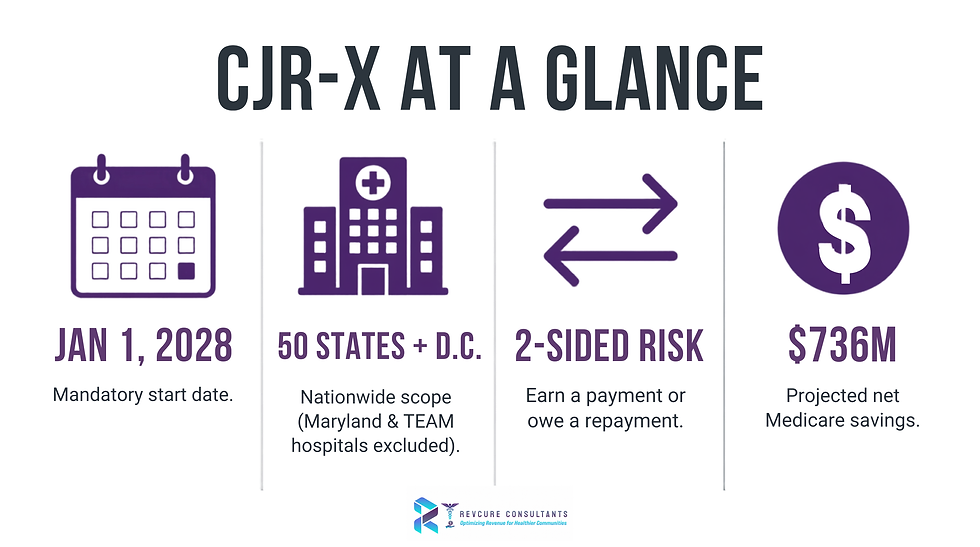
CJR-X — a nationwide, mandatory expansion of the Comprehensive Care for Joint Replacement model — starts January 1, 2028, and will apply to nearly every acute care hospital performing hip, knee, or ankle replacements
CJR-X carries two-sided financial risk: hospitals can earn reconciliation payments or owe CMS a repayment, based on episode spending and quality performance
The TEAM bundled payment model (already mandatory since January 2026) gets new spinal fusion MS-DRGs and a rule preventing episodes from double-counting when CJR-X and TEAM overlap
Coding and CDI teams have six new MS-DRGs to learn before October 1, 2026: three for spinal fusion, two for periprosthetic joint infection revisions, two for cardiac pacemaker revision/replacement
The low-volume hospital and Medicare-Dependent Hospital (MDH) payment programs are set to expire after December 31, 2026 under current law — a real financial cliff for small and rural hospitals if Congress doesn't act again
What the Rule Actually Does
On July 31, 2026, CMS issued the FY 2027 Hospital Inpatient Prospective Payment System (IPPS) final rule (CMS-1849-F), published in the Federal Register on August 4. It's the annual rule that resets Medicare's inpatient payment rates and policies — and this year it's carrying more than a routine update. Buried inside the payment-rate mechanics is a policy shift that will reshape how orthopedic service lines get paid for the next several years: CMS is taking a voluntary bundled payment model and making it mandatory, nationwide.
For hospital finance and revenue cycle teams, the practical question isn't whether this rule matters — it's which parts of it demand action now versus which parts are still 18 months out.
Bundled Payments Just Got Real: CJR-X Goes Nationwide
The Comprehensive Care for Joint Replacement model has run as a limited-market test since 2016. CMS's own evaluation found it produced $112.7 million in net savings across Performance Years 6 and 7 while maintaining quality — enough for the agency to expand it under its statutory authority to scale models that cut spending without cutting quality.
The expanded version, CJR-X, will be mandatory nationwide starting January 1, 2028, covering essentially every acute care hospital in the 50 states, D.C., and U.S. territories that performs lower extremity joint replacements (hip, knee, and ankle) and is paid under both IPPS and OPPS. The only carve-outs are hospitals already participating in the TEAM model and hospitals in Maryland.
Two things make this different from a typical quality program:
It's two-sided risk. Participants can receive a reconciliation payment from CMS — or owe CMS a repayment — depending on how their episode spending and quality performance compare to their target price. CMS projects it will pay participants $1.463 billion over five years while participants repay $1.855 billion, for roughly $736 million in net Medicare savings.
The clock is longer than it looks. CMS pushed the start date from its originally proposed October 1, 2027 to January 1, 2028 after commenters asked for more preparation time. That's a gift — but only if hospitals use the runway. Eighteen months is not a long time to build episode-cost visibility, post-acute network relationships, and physician alignment around a bundle you've never managed before.
TEAM Model: New DRGs and an Overlap Fix
TEAM — the Transforming Episode Accountability Model — has been mandatory for select hospitals since January 2026, running through 2030 across five surgical episode categories: CABG, lower extremity joint replacement, major bowel procedures, surgical hip/femur fracture treatment, and spinal fusion.
The FY 2027 rule finalizes three new MS-DRGs (523, 524, 525) specifically to better classify spinal fusion acuity and resource use — a direct signal that CMS wants tighter, more granular episode pricing for one of TEAM's highest-variability categories.
CMS also closed a gap that would have created real reconciliation headaches: if a beneficiary in a CJR-X episode has a procedure at a TEAM hospital that would normally trigger a TEAM episode during the CJR-X 90-day post-discharge window, that spending now stays inside the CJR-X episode instead of also starting a TEAM episode. Without this fix, hospitals running both models could have seen the same spending attributed twice — a reconciliation and audit risk that finance teams would have had to untangle after the fact.
New MS-DRGs Your Coding Team Needs to Know
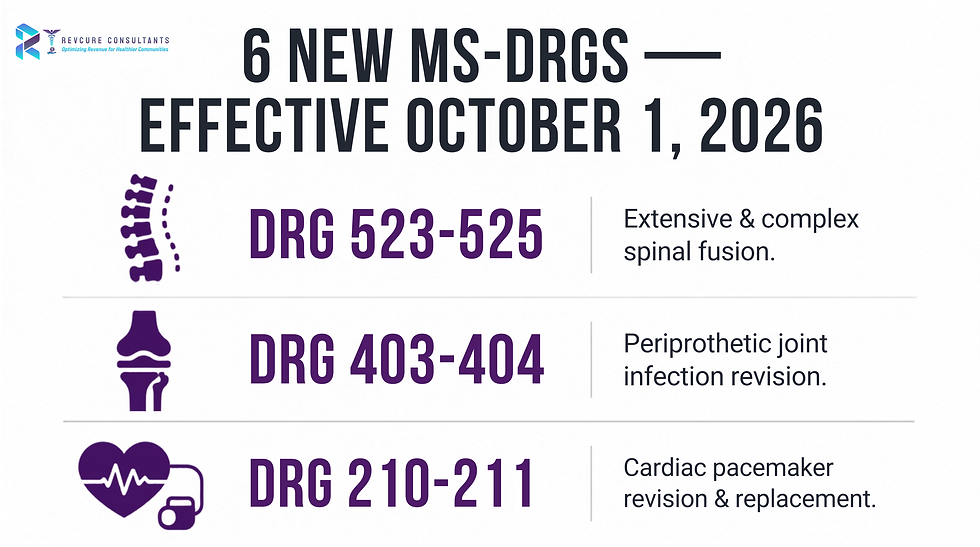
Effective with discharges on or after October 1, 2026, six new MS-DRGs go live:
523–525 — extensive and complex spinal fusion
403–404 — hip and knee procedures with a principal diagnosis of periprosthetic joint infection
210–211 — cardiac pacemaker revision and device replacement
CMS also finalized deletions of several existing MS-DRGs to make room for these. For coding and CDI teams, this isn't a minor update — DRG assignment accuracy on spinal fusion and joint infection revision cases now directly affects both standard IPPS reimbursement and, for CJR-X participants starting in 2028, bundled episode target pricing. Getting these wrong in either direction (under- or over-classifying complexity) has real financial consequences on both sides of the ledger.
The Number Everyone Will Ask About First: 2.3%
CMS finalized a 2.3% payment rate increase for FY 2027 — a 3.2% market basket increase offset by a 0.9 percentage point productivity adjustment, and a touch below the 2.4% CMS had originally proposed. That full increase is conditional: hospitals that don't submit quality data get 1.5%, hospitals that aren't meaningful EHR users get -0.1%, and hospitals that miss both get -0.9%. CMS estimates the changes will add roughly $2.9 billion in FY 2027 payments to acute care hospitals overall.
Two other financial items worth flagging for budget season:
Uncompensated care payments rise to $8.049 billion for FY 2027, a 2.9% increase from FY 2026's $7.821 billion — relevant for any hospital with meaningful DSH exposure.
Low-volume and MDH program status is uncertain. Under current law, the expanded low-volume hospital criteria and the MDH program expire December 31, 2026. Unless Congress extends them again — as it has in the past — the definition reverts to its stricter permanent form (fewer than 200 discharges, more than 25 road miles from another hospital) starting January 1, 2027. Rural and small hospitals relying on these payments should be modeling both scenarios now, not waiting to see what Congress does in Q4.
Where Physician-Led Insight Changes the Outcome
Bundled payment models live or die on documentation and coding accuracy — not because the coding itself is exotic, but because episode target prices are built on historical claims data, and every DRG assignment either sharpens or distorts that baseline. RevCure's physician-led teams build CDI and coding review around the clinical reality of the chart first, so that when a hospital's spinal fusion or joint replacement volume starts flowing through CJR-X, the documentation underneath it can withstand both routine coding audits and CMS reconciliation review. That's a different bar than “codes cleanly” — it's “codes cleanly and defensibly, at scale, under two-sided risk.”
What to Do in the Next 60 Days
Identify whether your hospital performs lower extremity joint replacements and confirm CJR-X applicability (nearly all IPPS/OPPS hospitals outside Maryland and current TEAM participants are in scope)
Pull 12 months of joint replacement (and, if applicable, spinal fusion) claims data to establish an internal cost-per-episode baseline before CJR-X pricing methodology is finalized
Audit current DRG assignment practices against the six new MS-DRGs effective October 1, 2026, especially spinal fusion and periprosthetic joint infection revisions
If your hospital currently qualifies as low-volume or MDH, model your FY 2027 payments under both the extended and reverted eligibility criteria
Flag TEAM participants in your system: confirm the CJR-X/TEAM overlap rule is reflected in how your finance team tracks episode attribution starting in 2028
RevCure's physician-led team can help you build the coding and CDI foundation CJR-X will be priced against — before mandatory participation starts.
Frequently Asked Questions About the FY 2027 IPPS Final Rule
1. What is CJR-X and how is it different from the original CJR model?
CJR-X is the nationwide, mandatory expansion of the Comprehensive Care for Joint Replacement model. The original CJR ran in a limited set of markets on a largely voluntary basis; CJR-X will be mandatory for nearly all IPPS/OPPS-eligible acute care hospitals performing lower extremity joint replacements, starting January 1, 2028.
2. Which hospitals are exempt from CJR-X?
Hospitals located in Maryland and hospitals already participating in the TEAM model are excluded. Otherwise, participation is mandatory for eligible hospitals in all 50 states, D.C., and U.S. territories.
3. How does CJR-X financial risk work?
CJR-X uses two-sided risk: hospitals can receive a reconciliation payment from CMS when episode spending and quality performance beat the target price, or owe CMS a repayment when they don't.
4. What's changing with the TEAM model in FY 2027?
CMS finalized three new MS-DRGs (523–525) for spinal fusion episodes and a rule preventing double-counting when a CJR-X episode and a TEAM episode would otherwise overlap during the 90-day post-discharge window.
5. What's the topline Medicare payment update for FY 2027?
CMS finalized a 2.3% IPPS payment rate increase for hospitals meeting quality reporting and meaningful EHR use requirements — reduced to 1.5%, -0.1%, or -0.9% depending on which requirements a hospital misses.
6. Are the low-volume hospital and MDH payment programs going away?
Under current law, both expire after December 31, 2026, reverting to stricter permanent eligibility criteria starting January 1, 2027 unless Congress extends them again, as it has done in prior years.
Sources: CMS Fact Sheet, FY 2027 Hospital IPPS/LTCH Final Rule (CMS-1849-F); McDermott+ “CMS releases FY 2027 IPPS final rule” (Aug. 4, 2026); Ropes & Gray “FFY 2027 IPPS and LTCH Final Rule” (Aug. 6, 2026); Federal Register, 91 Fed. Reg. 49570 (Aug. 4, 2026).


Comments