First Public Prior Auth Reports: What CFOs Should Do Now
Updated: Jul 2
What the First Public Prior Auth Denial Reports Reveal — and How to Use Them at the Negotiation Table
For the first time in history, hospitals can pull up a payer's website and see — in black and white — how often that payer denies prior authorization requests, how long they take to decide, and how many of those denials get overturned on appeal. The data is public. The accountability is new. And most hospital finance teams haven't done a thing with it.
Under the CMS Interoperability and Prior Authorization Final Rule (CMS-0057-F), Medicare Advantage organizations, state Medicaid and CHIP programs, Medicaid managed care plans, and Qualified Health Plan issuers on Federally-Facilitated Exchanges were required to publish their 2025 prior authorization metrics by March 31, 2026. Six weeks in, payer data is sitting unused on landing pages while denial volumes keep climbing. Here's how to change that.

Key Takeaways
Payers had to publish 2025 prior auth metrics by March 31, 2026 under CMS-0057-F
Reports include approval/denial rates, turnaround times, and appeals outcomes
New 7-day standard / 72-hour expedited decision deadlines took effect January 1, 2026
Payers must now provide specific reasons for every denial
Hospitals can use public prior auth reports to build payer scorecards, strengthen appeals, and reframe contract negotiations
Drugs are excluded from this first round; CMS-0062-P proposes adding them
What the Reports Actually Contain
Approval rates and denial rates for non-drug medical items and services
Average decision turnaround times for standard and expedited requests
Volumes of requests extended beyond initial decision windows
Appeals outcomes — including how many denials were ultimately overturned
Reporting level varies: MA reports at contract level; Medicaid/CHIP FFS at state level; managed care at plan/carrier level; QHPs at issuer level
Note: Drug prior authorizations are excluded from this initial round. CMS's proposed rule CMS-0062-P (released April 10, 2026) would extend reporting to drugs and add raw numeric counts alongside percentages.
Why This Data Is More Useful Than It Looks
Critics have called the first batch of reports inconsistent — and they are. Payers post the data in different formats, on different pages, with different levels of granularity. UnitedHealthcare, for example, reports approximately 95% approval when appeals are included, with a 24-hour average turnaround on Medicare Advantage decisions. Other payers report far less favorable numbers, and the variation across plans within a single payer family can be striking.
That variation is the opportunity. Hospitals now have:
A benchmark for what "normal" looks like at each payer they contract with
A way to detect contract-level outliers — where one payer is denying at materially higher rates than peers
Documented payer-reported turnaround times that can be cited when authorization delays cause downstream care or revenue issues
Three Ways to Operationalize the Data
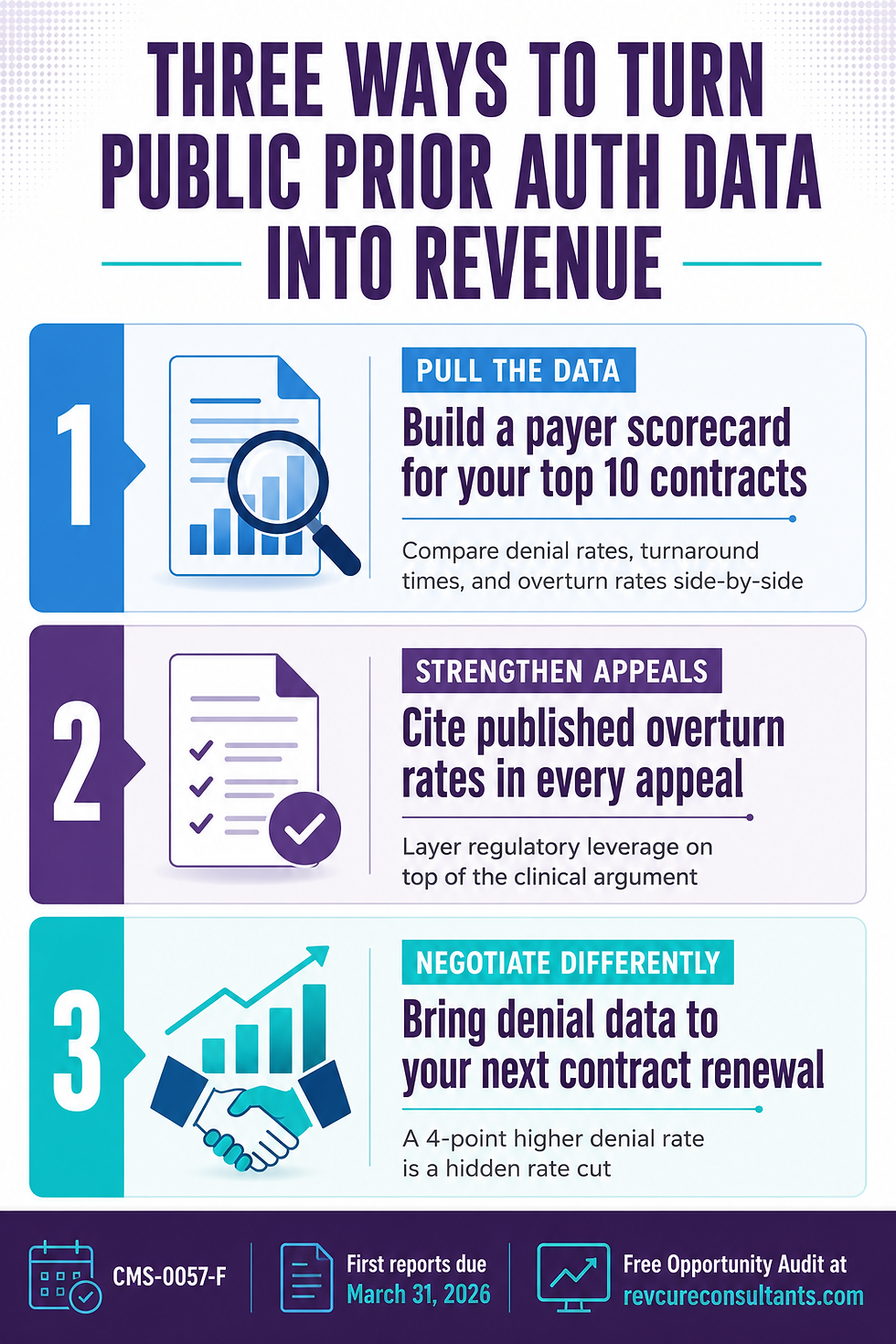
1. Build a payer scorecard for your top 10 contracts.
Pull the published 2025 metrics for every payer representing more than 3% of your net patient revenue. Compare denial rates, overturn rates, and turnaround times side-by-side. Layer in your own internal data — your initial denial rate, your appeal win rate, your average days in A/R — and the gaps become negotiation leverage.
2. Use overturn rates to strengthen appeals.
When a payer's own published data shows that a significant share of denied PAs are overturned on appeal, that's the most cost-effective appeal authorization a CDI or denials team will ever get. Cite it. The clinical argument carries the case, but the published overturn rate makes clear that this payer regularly reverses its own decisions when challenged.
3. Bring the data to contract renewal meetings.
Most hospital-payer contracts are negotiated on rate, with administrative burden treated as a soft topic. Public denial data lets CFOs put administrative burden on the rate-sheet. If a payer's denial rate is 4–5 points above peers, the effective reimbursement is materially lower than the contracted rate suggests — and the conversation shifts from "we'd like better rates" to "we'd like rates that match the actual cost of doing business with you."
The Companion Compliance Story Most Teams Are Missing
As of January 1, 2026, the same rule requires impacted payers to make standard prior authorization decisions within 7 calendar days and expedited decisions within 72 hours — down from the prior 14-day standard. Payers must also provide a specific reason for every denial, communicated through portal, fax, email, mail, or phone.
That changes appeals math. A vague "not medically necessary" no longer satisfies the rule. When a denial reason is missing, generic, or boilerplate, that's a procedural defect — and it belongs in the appeal letter alongside the clinical argument.
Where Physician-Led Insight Changes the Outcome
Prior auth denials don't get overturned by stronger templates. They get overturned by clinical reasoning that matches the payer's medical necessity criteria — written in language a physician reviewer recognizes as their own. RevCure's physician-led teams build appeals around the clinical evidence first, with the regulatory and contractual leverage layered on top. That's the combination the published data was designed to enable.
What to Do in the Next 60 Days
Assign one analyst to pull and archive every top-contract payer's published metrics
Build a one-page payer scorecard and share it with your managed care and denials teams
Audit your appeal letters to make sure they cite published overturn rates where available
Flag any payer whose denial rate exceeds peers by 3+ percentage points for your next contract review
The hospitals that turn public payer data into negotiation leverage in 2026 will recover material revenue that competitors leave on the table. RevCure's physician-led team can build the scorecard, write the appeals, and prepare your contract analysis.
Frequently Asked Questions About Public Prior Auth Reports
1. Which payers are required to publish prior authorization metrics
Medicare Advantage organizations, state Medicaid and CHIP fee-for-service programs, Medicaid managed care plans, CHIP managed care entities, and Qualified Health Plan issuers on Federally-Facilitated Exchanges
2. What metrics must be published?
Approval rates, denial rates, decision turnaround times for standard and expedited requests, the number of extended reviews, and appeals outcomes for non-drug medical items and services.
3. Are drug prior authorizations included?
Not in this round. The April 2026 proposed rule (CMS-0062-P) would extend reporting to drugs and add raw numeric counts.
4. Where can hospitals find the reports?
On each impacted payer's public website. Format and location vary widely. Building a central archive is recommended.
5. How can hospitals use the data in appeals?
Cite the payer's published overturn rate when challenging denials, and flag any denial that fails the new requirement to provide a specific reason.
6. Does the 7-day / 72-hour decision deadline apply to all payers?
It applies to Medicare Advantage, Medicaid, and CHIP plans. ACA Marketplace plans (QHPs on FFEs) are excluded from the timeline portion of the rule.


Comments