FY 2027 IPPS Final Rule: A Physician-Led Read Before Oct 1

Key Takeaways
The FY 2027 IPPS Final Rule was released July 31, 2026 and takes effect October 1, 2026
The 2.3% payment increase (down from 2.4% proposed) masks meaningful DSH, wage index, and payer-mix variation
Three new MS-DRGs require CDI preparation: extensive spinal fusion (523–525), PJI hip/knee (403–404), and cardiac pacemaker revision (210–211)
A new sepsis readmission measure raises the stakes on sepsis documentation on both the front and back ends of the stay
TEAM refinements expand spinal fusion episodes; CJR-X mandatory joint replacement expansion begins January 1, 2028
The PACT DRG list is shifting — legacy workflows need to be updated before October 1
CMS released the FY 2027 IPPS Final Rule on July 31, 2026. It was published in the Federal Register on August 4. The effective date is October 1 — about five weeks from publishing this post. Every RCM firm in the market is publishing its "here's what changed" summary. This isn't that. This is what actually changes for hospital revenue cycle, filtered through a physician-led read of what documentation, coding, and denial teams need to do before the rule takes effect.
Five things matter more than the rest.
1. The 2.3% Raise Won't Land Where You Think It Will
CMS finalized a 2.3% payment update for hospitals that successfully participate in quality reporting and EHR programs — a slight cut from the 2.4% proposed in April. Total IPPS payments are projected to rise by roughly $2.1 billion in FY 2027.
But the headline number masks the actual margin picture. DSH payments dropped $200 million from FY 2026, even as uncompensated care payments rose $230 million — a net near-wash at the aggregate level, but a real disruption for DSH-eligible hospitals.
Layer in the ongoing wage index shifts following Bridgeport Hospital v. Becerra (CMS added a narrow transitional exception for low-wage-index hospitals affected by the policy's discontinuation), and the 2.3% figure is doing a lot of concealing.
Physician-led read: model your hospital's actual FY 2027 payment position by payer mix and geography before you brief the board. The average hospital sees 2.3%. Your hospital may see meaningfully less.
2. Three New MS-DRGs Your CDI Team Should Already Be Preparing For
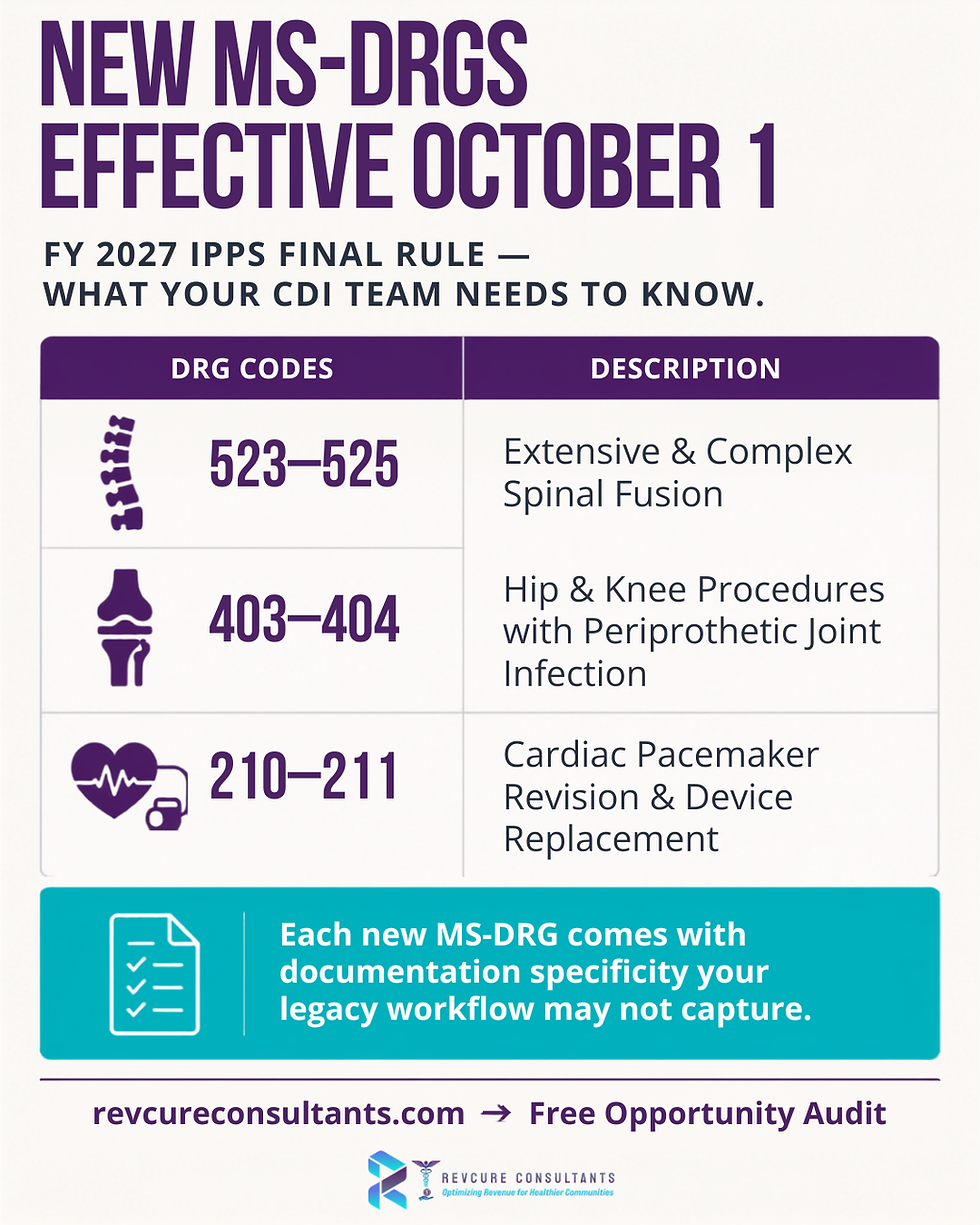
CMS finalized three high-visibility MS-DRG changes that will require documentation and coding preparation before October 1:
MS-DRGs 523–525 — extensive and complex spinal fusion procedures (new)
MS-DRGs 403–404 — hip and knee procedures with principal diagnosis of periprosthetic joint infection (new)
MS-DRGs 210–211 — cardiac pacemaker revision and device replacement (new)
Each of these new DRGs comes with documentation specificity requirements that didn’t apply under the current structure. Spinal fusion cases in particular have been among the most complex inpatient procedures to code, where minor ICD-10-PCS errors can shift DRG assignment, reimbursement, and audit exposure. New DRGs mean new coding logic, new severity thresholds, and new places for documentation gaps to become revenue leaks.
Physician-led read: pull your top spinal fusion, joint infection, and cardiac device revision cases from the last 12 months and audit how the documentation would map under the new MS-DRG structure. That audit is a two-week project. The window closes on October 1.
3. The New Sepsis Readmission Measure Raises the Stakes on Sepsis Documentation
CMS finalized the addition of a new measure to the Hospital Readmissions Reduction Program: the Hospital 30-Day, All-Cause, Risk-Standardized Readmission Rate Following Sepsis Hospitalization, beginning with the FY 2029 program year.
This is a bigger deal than it looks. Sepsis is already the most-audited DRG in the country and the most common target of clinical validation denials. Adding a readmission-following-sepsis measure means sepsis documentation now has payment implications on both ends of the stay:
Front end — the DRG assignment and the clinical validation defense
Back end — the readmission risk calculation
Combine that with the still-unresolved Sepsis-2 vs. Sepsis-3 criteria divide between CMS and many payers, and sepsis documentation quality moves from “important” to “top of the CDI priority list.”
Physician-led read: your organizational sepsis definition — the one your CDI team, coders, and physicians work from — needs a review before October 1. If it hasn’t been updated to reflect current payer criteria, current CMS guidance, and now the readmissions measure logic, the gaps compound.
4. TEAM Refinements and the CJR-X Countdown Demand Episode-Level Thinking
CMS finalized several refinements to the Transforming Episode Accountability Model (TEAM) — the mandatory episode-based payment model that launched January 1, 2026 — including expanded eligible spinal fusion episodes, updated target price methodologies, and modified attribution approaches.
More consequentially, CMS finalized the CJR-X model — the mandatory nationwide expansion of the Comprehensive Care for Joint Replacement bundle — with a start date of January 1, 2028 (three months later than proposed). CJR-X will apply to hip, knee, and ankle replacements across inpatient and outpatient settings for nearly all IPPS hospitals.
Together, TEAM and CJR-X mean the revenue cycle for a growing share of surgical volume is no longer a per-claim game. It’s an episode-of-care game. Documentation, coding, and denial management for these procedures now determine bundle-level performance, not just DRG-level payment.
Physician-led read: hospitals treating TEAM and CJR-X preparation as a value-based care or population health project are missing where the revenue actually lives. The documentation and coding decisions inside each episode determine the winners and losers. That’s a CDI and denials conversation, not just a strategy conversation.
5. The PACT List Is Shifting — Again
The Final Rule includes changes to the MS-DRGs subject to the Post-Acute Care Transfer (PACT) policy — the same list we flagged in our earlier analysis of transfer DRG underpayments. Any hospital workflow that depends on a fixed PACT DRG list baked into legacy processes is going to be out of alignment on October 1.
Physician-led read: confirm your billing and case management workflows are pulling from the FY 2027 PACT DRG list, not FY 2026. The condition code 42 and 43 workflows that recover full DRG payment when planned post-acute care doesn’t materialize are as important as ever — and now applied against a shifted list.
What to Do Before October

Model your FY 2027 payment position by payer mix, DSH status, and wage index — don’t rely on the aggregate 2.3% number
Audit the last 12 months of spinal fusion, PJI, and cardiac pacemaker revision cases against the new MS-DRG structure
Update your organizational sepsis definition and align CDI, coding, and physician workflows before the sepsis readmission measure baseline period begins
Treat TEAM and CJR-X as CDI and denials priorities, not just value-based care projects
Confirm your PACT workflow is pulling from the FY 2027 DRG list
Frequently Asked Questions About the FY 2027 IPPS Final Rule
1. When was the FY 2027 IPPS Final Rule released?
CMS released the FY 2027 IPPS Final Rule on July 31, 2026. It was published in the Federal Register on August 4, 2026, with an effective date of October 1, 2026.
2. What is the FY 2027 IPPS payment increase?
CMS finalized a 2.3% payment increase for hospitals that successfully participate in quality reporting programs, down from the 2.4% proposed. Total IPPS payments are projected to increase by approximately $2.1 billion in FY 2027.
3. What new MS-DRGs are created in the FY 2027 IPPS Final Rule?
CMS finalized new MS-DRGs for extensive and complex spinal fusion procedures (MS-DRGs 523–525), hip and knee procedures with principal diagnosis of periprosthetic joint infection (MS-DRGs 403–404), and cardiac pacemaker revision and device replacement (MS-DRGs 210–211).
4. What is the CJR-X model and when does it start?
CJR-X is the mandatory nationwide expansion of the Comprehensive Care for Joint Replacement model, covering hip, knee, and ankle replacements across inpatient and outpatient settings for nearly all IPPS hospitals. It begins January 1, 2028 — a three-month delay from the proposed start date.
5. What is the new sepsis readmission measure?
CMS finalized the Hospital 30-Day, All-Cause, Risk-Standardized Readmission Rate Following Sepsis Hospitalization measure for the Hospital Readmissions Reduction Program, beginning with the FY 2029 program year. It makes sepsis documentation a direct payment issue on both the front and back ends of the stay.
6. Does the FY 2027 IPPS Final Rule change the Post-Acute Care Transfer (PACT) policy?
Yes. The rule includes finalized changes to the list of MS-DRGs subject to the Post-Acute Care Transfer policy. Hospital workflows relying on a fixed transfer DRG list should be updated before October 1, 2026.


Comments